I had seven hours to wait until my bus departed, so I wandered around the city. Kisumu is full of markets and has a large central park. After a while I found an interesting pick-up basketball game sat down in the park to watch. Duncan and Alfred saw an mzungu sitting there and ventured over. They were dressed well spoke eloquently. They seemed different from the other street boys. We sat together for two hours while they told me their stories. Duncan even wrote his down for me. It goes like this:
“I was born in the year 1989. I was born out of wedlock while my mum was a school going girl. I grew up as a young boy under the care of my beloved grandmum in Siaya until it reached a time when I had to start my primary education. I learned up to class six and my mum came and took me to Nairobi where I met a man whom my mum forced me to call ‘dad.’ Surely he wasn’t my dad because every time he would beat me and tell me that [since he was with my mom, he could also do anything he wanted to me.]
Unfortunately, when I reached standard seven, my beloved mum died in a road accident. It was painful, but God relieved me from the pain. During my last primary year, my dad (the man) got drunk, beat me, and sent me to my grandmum. There I did my primary exams.
Come my Form One year in Secondary School, my dad died and I was totally rejected by the rest of my family and relatives. I went to the streets. Life in the streets is worse than any other life.”
Duncan and Alfred both scored in the top levels nationally on their primary school exams. They would be valedictorians in most Kenyan schools. Each is 17 years old and hopes one day to get off the streets and go back to class. If anyone is interested in helping with a school sponsorship, send me an email at kenyaconnection@gmail.com

Monday, April 23, 2007

Chickens in Church
On Sunday we stopped by St. Mark’s and picked up 25 children to accompany us on the next leg of our journey. From Orengo, Akoko Church was still another 12 kilometers away and the children were to perform a song and dance routine they had been practicing for weeks. They were all very cute and excited because today they were borrowing colored shirts to wear as uniforms. When we arrived at Akoko we found hundreds of villagers waiting for the monthly all-parish gathering. During the four and a half hour Luo service, we prayed, sang worship songs, listened to Bible stories, shared holy communion, and watched parishioners bring tithes of rice, maize, eggs, and live chickens.
The Trip to Orengo
I knew there was a problem when the metal door slammed shut. I froze and watched the bus slowly drive off. Jackson and I were supposed to be on that bus. Jackson still hadn’t arrived. He was with the police; arrested for riding on the wrong matatu, or not wearing a seatbelt, or some such nonsense. . .This is how our journey to Orengo began.
After Jackson escaped from the overzealous traffic police, we pleaded and begged our way on board a bus bound for Kisumu – a city 7 to 10 hours from Nairobi (depending on driver aggressiveness on the crater-filled roads). We made the trip in about 9, but as we approached Kisumu, torrential rains flooded the main city street knee deep. We grabbed our bags and alighted in the rain. Our friend Caroline was struggling through the surging waters in a hired tuk-tuk (golf cart). She motioned us inside and whisked us away to a matatu depot where dozens of travelers were stranded, waiting for a ride. We were fortunate enough to find space on a matatu headed for Bondo.
Matatus are normally designed for 16 people (14 passengers, one driver, and one conductor). However, twenty soaking riders filled our car along with their sopping wet luggage. The vehicle pushed its way through traffic and rushing water, but on the outskirts of the city we were stopped at a police checkpoint. An elderly women sitting on my rib cage began to pray that the police wouldn’t notice we were overcrowded. Other passengers whispered to one another in Ja-Luo. I searched frantically for anything resembling a seatbelt. Meanwhile, our conductor smiled and passed 300 shillings to a police officer. “Have a nice evening” he said. We continued on. We continued on and on and our matatu plucked another 4 passengers from the rain. For a good price they were allowed to force their way inside the wet car and ride. There was not enough room to close the door, so the conductor hung to the side of the van as we drove through the driving rain.
We continued for another hour like this, reaching Bondo late in the evening and in the midst of a blackout. The darkness was overwhelming, there was an occasional flickering fire, but nothing could illuminate the town around us. We left our matatu and found shelter in the awning of a kiosk while Caroline pondered our next move. Because of the rains, the “road” to Wichlum was flooded and impassable. Normally we could take a 30 minute piki-piki (motorcycle) taxi to Wichlum, and from there a boda-boda (bicyle taxi) to Orengo. But now we were stranded. Caroline considered our options and contacted two friends. They came with a car, we piled in, and navigated our way through the dark and mud to a church in Gomba. There we were greeted by the church’s Rural Dean with three of his nine children and invited to stay for the night. The hospitality was amazing. They slaughtered a chicken and prepared it for us, along with ugali, greens, and fresh yogurt.
After resting for the night and taking Chai with the Dean, we continued our journey. Our group descended towards the edge of Lake Victoria, passing fields of maize and millet and wandering “primitive cattle.” We hoped to take a boat to Nyamuua, but unfortunately, as we approached the shore we learned that there were no boats docked at Nango because of an infestation of hippos. Furthermore, the path to Orengo was still too wet for bicycles or motorcycles. We would have to walk. The hike was about 15 kilometers and took every bit of strength in the Nyanza sun. . .We arrived at Caroline’s homestead early in the afternoon. For the next two hours relatives and neighbors came to greet us and pray. Then they offered us a feast of fish while Jackson and I fell asleep in our chairs.
A Day at Bomas


Over Easter, I had the chance to visit Bomas of Kenya. It is a large National Park in Langata that features replica homesteads from many different tribes along with a theatre with daily shows of African acrobatics and traditional dancing. I went with a group of guys from Light and Power. Here’s a few pictures:
Light and Power Retreat


In March we held a team building and training retreat for the guys at Light and Power. We held two sessions from the week-long retreat at Nairobi Arboretum. Here are a few pictures from our time there:
Saturday, February 10, 2007
A New Home and a New Roomate


Set on the banks of the Nairobi River. It’s little more than a trickle and a moat of mud, but the landscape is green, the neighbors are friendly, and the setting is serene. This is my new home and so far I like it a lot. I just moved in yesterday and am still getting settled. The flat is relatively small, but it has one bedroom with a kitchenette, full bath, and sitting room. There’s even a small yard and laundry area out back. I’ll be sharing the place with a colleague from Light and Power, Tim Omwanza. Tim has become a good friend and is a talented musician who leads worship at a local church. Tim also helps mentor the guys at Light and Power and currently serves as the Centre’s Director of Marketing.
How I Spend the 9 to 5

My schedule has changed a lot since I’ve been here, but recently I’ve found a groove and now have a set routine for the next few months. I’ve been spending my mornings at Light and Power in the Gatina slum. I hold Bible studies and prayer meetings with a group of guys from 8-8:30, then work with them to make paper bags. There’s about 12 guys at Light and Power, plus our cook Beatrice. Most of the guys have been making bags for a long time and see Light and Power as an opportunity to provide an income for themselves and their families and also to help their community. The guys are an incredibly diverse group. They represent nearly a dozen different tribes. Some grew up in strong homes with traditional families, others spent their childhood on the streets or bouncing from one home to another. Some graduated high school at the top of their class and are now in University part-time. Others never went to school and lack any formal education whatsoever. Some are Christian, some are Muslim. All of them are trying to escape destitute poverty and bring hope to Gatina.
In the past two months, we’ve been through a lot of struggles together. These guys have a lot of talents and gifts and a strong determination to succeed. They’ve lived through crime, disease, hunger, abuse, and a lot of hardship. Many were manipulated and mistreated by leaders at the Centre before, so there is still a lot of mistrust, suspicion, and theft. We even had a small revolt/uprising and had to dismiss one of the members because of some of the trouble he had been bringing. As a team, however, we’ve been growing together, and we have a solid leadership group that hopes to cultivate a strong sense of community at the Centre. We’ve also been working with Amber and Anne and the Light and Power Board of Directors to try to stabilize the bag business, and enhance the Centre’s impact on the surrounding slum. Recently we’ve moved into a new home, updated our business and management structures, solidified our accounting, developed a catalog, and expanded our marketing base. Amber and Anne have also started a Saturday program with games and activities for children in the slum. In addition, Beatrice holds a small literacy program and Bible club for girls twice a week in the new house. She hopes to reach more young girls in the future and we’ve been discussing strategies to do this. Unfortunately, Beatrice doesn’t speak much English, so I’ve been trying to learn Swahili. We do our best to communicate to one another, but sometimes it comes across kind of funny.
I take Swahili classes for a couple hours three days a week. Amber, Anne, and I found a great tutor nearby, and we’ve been taking classes separately, but enjoying our interactions with our teacher, Peter. Peter has been focusing on conversational Swahili and we’ve also started some basic reading. Learning a language on top of everything else is challenging and frustrating. It makes my brain tired, but Swahili is a beautifully poetic and at the same time amazingly well structured language.
In the afternoons, when I’m not studying Swahili, I teach three days a week at Akiba School. I have 9th and 10th graders for Computer Studies, which means introduction to computers and the basics of Microsoft Windows and Office. Many of the students are very bright and eager to learn, and several are Light and Power members who have received sponsorships to attend school. Classes are going well, but teaching requires a lot of creativity. The school is blessed to have a computer lab, but there are only a few working computers and many of those have viruses or other problems. I have classes with up to 36 students. With the limited number of computers and frequent power outages, teaching here is a real challenge. I end up drawing a lot of pictures on the board.
On Wednesdays and sometimes Saturday afternoons I work with a small Computer College at St. Luke’s Church in Kibera. I’ve been helping with some of their classes and also with their business structure. The college has a solid board of faithful Kenyan men and women who volunteer their time to provide education and positive activities for youth in the slums, many of whom are idle, unemployed, and tempted by a life of crime. The college offers a variety of courses as well as job training and ministry activities. They minister to many Kenyans in the neighboring slum, which is the largest in Sub-Saharan Africa. There are also several Sudanese students, and there are large Sudanese and Ethiopian communities that worship in the church during the week. Recently several of the school’s graduates found successful jobs in Nairobi and Southern Sudan. The college hopes to expand its outreach in the future and partner with other churches. They have plans to plant computer schools in neighboring urban slums as well as in rural areas of Kenya. The founder of the College is a good friend and from time to time he invites me to visit with him and help “facilitate” local church services. Jackson is currently working his way through seminary, studying urban ministry and missions. He also teaches and preaches at many churches and youth conferences in addition to working with the college. If anyone is interested in helping with his seminary tuition, let me know.
In general, life here has been an adventure: busy, tiring, and often a struggle, but never boring. I’ve been learning a great deal and am grateful for my friends here and for your support back home. Most of the time, I’m not sure what I’m doing, but God has been faithful, opened many doors, and helped me through many challenges. Thank you so much for your prayers and support.
Close Encounters with Slimy Creatures

As I went to wipe my face, I had an unsettling, slimy surprise. A giant slug had somehow managed to climb through the window and settle down to sleep inside my towel. As you may imagine, I was quite surprised to see him there just two inches from my nose. I threw the towel across the room and sent the slug crashing into the wall. He was unfazed. This was by far the largest slug I had ever seen. . .Now you can see him too, hanging out with Abraham Lincoln. I must say, the picture doesn’t do him justice, but maybe you can get an idea. He’s really really quite fierce looking in person. . .Apparently giant slugs are fairly common in Nairobi. Recently I ran into a dozen or more in one of the slums where I work. I also encountered some other slimy creatures in the slum. The last couple of weeks I had been experiencing fatigue and stomach issues and wanted to get it checked out. I went to the doctor to learn that I had “developed” worms. Because of problems with water purity, sanitation, and living in close proximity with animals, worms are a normal part of life in the slums. In the poorer areas, one common cure is to drink extremely potent alcohol in hopes that it will kill the worms or convince them to leave. Fortunately, pills are also available. I’ve been encouraged to take them and de-worm regularly. Worms are a major menace, but if treated are not a significant health concern.
Traffic Jam

In a country where there are no stop signs, traffic lights are optional, and everyone has the right of way, traffic jams can be a bit tricky. When you also consider that paved roads are littered with potholes and dirt roads become impassable when it rains, traveling in Kenya can be quite difficult. Here’s one of the roads I’ve had trouble on recently. Later a larger truck broke down, blocking traffic on a major highway near Maasai Mara. Dozens of cars and buses tried to go around the truck, but got stuck in the mud. Meanwhile, the two lane road became a six lane parking lot. I waited for a little over an hour with hundreds of others who got out of their cars to push, offer advice, or just watch the drama. . . Despite the difficulties, I’ve come to learn that Kenyan drivers are remarkable efficient at getting around. Matatu drivers are especially good at inventing shortcuts, racing through round abouts, or just driving through obstacles.
Sunday, December 31, 2006
Safari at the Mara

Last week we went on a short safari in the Maasai Mara. We stayed in upscale tents on the edge of the National Park and spent a few days driving through the wilderness viewing the animals. We saw all kinds of creatures and had close encounters with lions, cheetahs, elephants, and antelopes. At one point we stopped the van to watch a lioness and two cubs in the grass along the dirt road. After a few minutes of photography and observing the cubs wrestle and play, we heard Anne scream. While all of us were focused on the lioness and cubs, another lion had come up behind the car and was standing right outside our window. This lion was watching us carefully and slowly made a half lap around our car before joining its family in the bush.
Watch our Journey to the Mara:
Mount of the Buffalos
The hike up Kilima Mbogo was long, but not too steep. We started hiking at mid-day so the sun was quite intense. Kilima Mbogo is home to many antelopes, baboons, and other creatures, but is known primarily for the many buffalos that gather on its slopes. Hikers are required to travel with an armed escort for protection from the beasts as well as from potential bandits. Our guard was named Benjamin and he hiked the whole day carrying his gun without a single drop of water. Half way up the mountain we came across the tombstone of Sir William MacMillan, a wealthy settler and close friend of Teddy Roosevelt. William’s dying wish was to be buried at the top of Kilima Mbogo, but since he was a rather large man (400 lbs), his servants could only take him half way. We were the only hikers to go up Kilima Mbogo the day we went, and it was very calm and peaceful at the top. We saw lots of birds, heard a few animals rummaging around in the bush, and enjoyed spectacular views of the Athi River and surrounding farms and forests.
Fourteen Falls

Recently Amber and I took an excursion to Fourteen Falls and Kilima Mbogo, two lesser visited National Parks outside of Thika. The region is home to the Kamba peoples and features forests and farming communities as well as picturesque waterfalls flowing from the Athi River. To get close to the falls, we jumped in a makeshift wooden boat belonging to a local fisherman and were paddled across the river to a small island. The island was home to goats and mudfish, as well as a group of boys who spend their days swimming in the river and jumping off the cliffs over the falls. They offered to teach us cliff diving and showed us the best places to jump. We decided to pass this time around. Here’s a picture of Amber with her new friends at the falls.
NEW: Watch a video of our trip to Fourteen Falls
Corruption 101
On the way back from one of my visits to the landlord’s office, my matatu was stopped by the police. Something about having too many people on board. A child was sitting on someone’s lap, so there were 16 of us in the van instead of the requisite 15. After we were pulled over, a police officer confiscated the van keys. Meanwhile the driver and conductor argued vehemently and tried to convince the police to leave us alone. After a few minutes another officer hopped in the front seat of the van, returned the keys, and instructed the driver to start moving. He pointed out directions for the van to travel and several of us thought he was taking us all to the police station (which apparently is not uncommon in Kenya). At this point, two passengers in the front seat began collecting bribe money. One man refused to pay and pleaded with the officer to let him go because he had important business and was in a hurry. After ten minutes of arguing, the matatu driver handed the officer a wad of bills. The officer smiled, got out of the van, and told us to continue on our journey.
Lying Lies and the Liars who Tell Them
Washington D.C. has plenty of con artists, but Nairobi has more than its share too. Recently, I’ve been learning that real estate agents in Kenya are notoriously deceptive. I’ve heard stories of agents who’ve collected viewing fees or deposit money and run off. Others are known to create fake leases and even hand out phony keys to already occupied flats. As I’ve been searching for a new flat, I’ve had my own experiences with deception. The real estate agent I had lied about rental price, security and water fees, apartment availability, and tenancy duration, all in an effort to extract supposedly refundable viewing fees based on a false contract. I lost about $40, but in the process was able to find a great flat. I’ve met with the landlord several times and it’s legitimate. I will be moving in to my new home within the next two weeks. It is a 1br flat in a great location and is only a few blocks away from where my friends amber and anne are staying.
Tuesday, December 05, 2006
Closing Day at Akiba
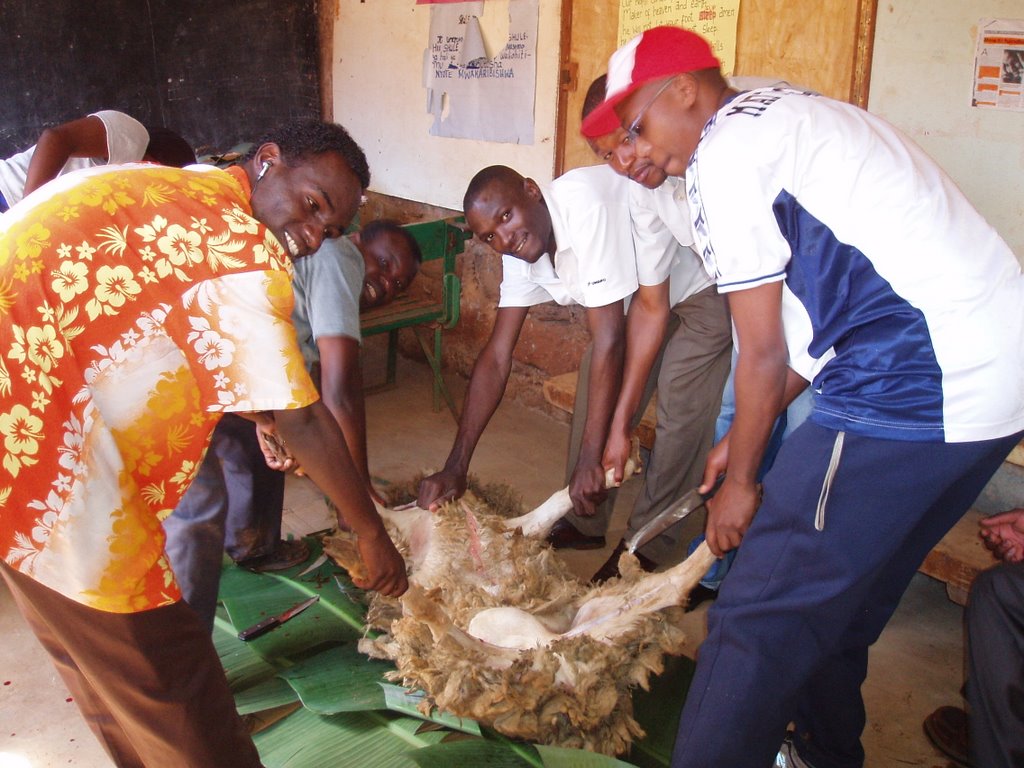
Students and teachers celebrated the end of the year at Akiba with skits, songs, poems, and even an eating competition.. . .When all the students left, the teachers threw another party to celebrate. We played volleyball, basketball, and soccer, slaughtered a sheep, ate chapattis, and danced wildly to reggae praise music. Here’s a picture of several of the teachers preparing Abe the sheep. Kinda makes me want to eat more vegetables.
Jesus in the Slums

“Go out quickly into the streets and alleys of the town and bring in the poor, the crippled, the blind, and the lame. . .Go out to the roads and country lanes and make them come in, so that my house will be full” – Luke 14:21,23
“Let the little children come to me, and do not hinder them, for the kingdom of God belongs to such as these. I tell you the truth, anyone who will not receive the kingdom of God like a little children will never enter it.” Mark 10:14-15
“Come to me, all you who are weary and burdened, and I will give you rest. Take my yoke upon you and learn from me, for I am gentle and humble in heart, and you will find rest for your souls. For my yoke is easy and my burden light.” – Matthew 11:28-30
“I am the bread of life. He who comes to me will never go hungry, and he who believes in me will never be thirsty.” – John 6:35
Swahili in Syngala
On Sunday, I went with some Kenyan friends from Carlile College to Emmanuel church in the Syngala region of Kibera (i'm not sure if that is how you spell Syngala, there weren't any signs, people just said we were in Syngala). Kibera is the largest slum in the world and an area of great poverty, malnutrition, and disease. That said, it is actually one of the nicer slums in Nairobi and has been improving dramatically in the last ten years. Most of the homes here are made of mud and tend to be cooler and believe it or not provide better protection from the elements than the corrugated tin and plastic of other slums. Also, there is a very strong sense of community in most regions of Kibera and crime rates are remarkably low compared with other slums. Still, there are very few toilets, little sanitation, and many idle, uneducated children. . . During the walk to Emmanuel Church, I was greeted by many smiling children chanting “how are you? how are you?” (for most of them the only words they know in English). I was also greeted by some patrons of a local bar as “mzungu”, “white man”, and my personal favorite “coloniser.” . . .At Emmanuel Church I was asked to preach during the Swahili service. Because of the shortage of clergy, churches in Kenya tend to encourage lay participation and are always excited to receive missionaries. By God’s grace I shared on Psalm 27 and did my best with Swahili and with the help of a translator. Even though I didn’t understand 95% of what was going on, I felt strangely connected to the people and to the Lord, and I am grateful to my friend Jackson for taking me along. After the services we enjoyed some Chai together and began the long walk back to the matatu stand.
Nyama Choma

Nyama Choma means roasted meat. It is a lightly seasoned staple of the Kenyan diet and is commonly shared at celebrations. Here’s a group of us gnawing on our nyama choma at St. Paul’s University in Limuru. The group is Graham, David, Charles, Amber, and myself. Graham has been in Kenya for the past couple of months working with Comfort the Children and helping with an orphanage about an hour and a half north of Nairobi. David has been helping him out and is currently in driving school in Nairobi (by the way, I don’t know what they teach people in driving schools here because everybody drives like they are on crack). Charles is a student at St. Paul’s and a great conversationalist. We had a fun discussion the other night about witchcraft and the Kikuyu understanding of the role of deceased ancestors in the living community.
Where’s the Beef?

Eland are Africa’s largest antelope, weighing up to 1000 kg each. They are abundant in Kenya and can be found throughout much of East Africa. On Saturday, I sampled an Eland steak from a local Swiss restaurant. The restaurant specialized in cheese fondue, but the Eland was pretty good too. Eland tastes like beef, except even better.
Subscribe to:
Posts (Atom)